Friday, April 16, 2010

News Flash!: Signourney Weaver is a FCP


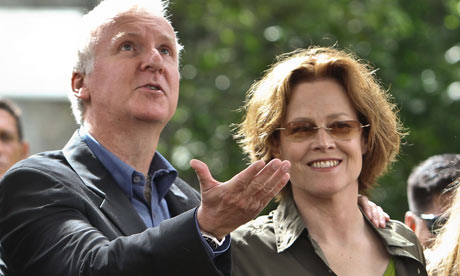
In a recent interview with a Brazilian news site, Sigourney Weaver claimed that the reason James Cameron and his mega-blockbuster
Avatar were beat out by Katherine Bigelow and The Hurt Locker, her production about the war in Iraq, was because Cameron was not a woman. Or, in her words, the reason Cameron could not snag the Best Director trophy was because ‘[he] didn’t have breasts.’ After reading Levy’s work earlier in the semester, these comments seem to shout ‘female chauvinist pig.’
Although Levy spends most of her book framing female chauvinism in terms of sexual exploitation—women who use their sexuality as a tool or who embrace raunch culture as empowering without fully considering its implications—she also argues that the lack of camaraderie among women only perpetuates their marginalization and subjugation. Levy delineates this phenomena into two components: women who have made it into the boys’ club and are hesitant to pave the way for more women and women who want to identify with a privileged (i.e. patriarchal) ideology. In a world where men still wield the power of the privileged it is often considered a shrewd move for women to align themselves with the boys’ club mentality.
Of course, this mentality runs counter to feminist ideals in a number of ways. According to Levy’s book, female chauvinist pigs achieve their brand of empowerment through eschewing traditional feminist notions of sisterhood, which undermine the established male-dominated hierarchy. This mentality, however, does not support other women and inhibits the formation of potentially powerful social collectives. Although Weaver’s comments seem pretty benign—after all, she did star in
Avatar, so it is understandable that she would have been rooting for it—they still typify the chauvinist attitude that undermines women’s efforts to become equally valued contributors to the workforce as well as society at large.
Of course, the politics that go into awards show decisions have long been a subject of speculation. Even the recent expansion of the Best Picture field at the Oscars from five nominated films to ten was largely the result of frustration that certain types of movies were being underrepresented, not due to lack of achievement but because Academy voters have been notoriously prejudiced against certain genres of film. (In particular, the change was believed to be in response to the exclusion of
The Dark Knight from the Best Picture nominees in 2009 and the widespread belief that that exclusion stemmed from Academy voter’s hesitance to recognize a superhero film, even an exceptional superhero film.) The politicization of Bigelow’s bid for Best Director, as the first woman in decades to be nominated and the first female director ever to win, was evident not only in the buzz leading up to Oscars night, but also in the ceremony itself.
Bringing Bigelow’s gender into the equation seemed to produce contradictory results. On one hand, it was a significant occasion and Bigelow’s recognition in a field that has been almost exclusively dominated by men was an important moment. However, the politicization of her nomination and bid for the statue also introduced speculation that she could not lose
because of her gender and invited comments such as Weaver’s to undermine the quality of her work. The lack of female directors recognized by the Academy has given rise to comments about gender imbalance in the field and speculation over reasons women’s contributions were going unnoticed. To snub a female director whose work is worthy of the win, some argued, would only cement the Academy’s reputation as having a boys’ club attitude. As such voters’ hands were forced to vote for Bigelow and The Hurt Locker if they wanted to maintain some semblance of gender equality. Even Barbara Streisand’s comment upon announcing Bigelow’s win (“about time”) noted both the lack of recognition of women and the growing restlessness surrounding it.
The contentiousness of Bigelow’s win and the dual response generated by it only further highlight the ways professional women’s achievements are being downplayed because of the marginalization of women as professionals on a larger scale. In many ways the difficulties women face parallel the racial inequalities based on white privilege that Peggy McIntosh discusses in her essay
White Privilege: Unpacking the Invisible Knapsack. McIntosh argues that subordination of marginalized groups can be attributed not only to outright acts of racism (or in this case, sexism) but also to the more subtle privileges enjoyed by those in power. As a member of a marginalized group, Bigelow does not have the privilege of her achievements being recognized as a result of her labor and skill and they are instead attributed to her gender. In this way, even women who manage to break into male-dominated fields and triumph face subordination by virtue of the very obstacles they overcome. The subtext of Bigelow’s win can be interpreted as follows: her work was noteworthy for a woman’s work; the Academy could not afford to ignore a woman’s achievement even if it did not match that of men in her field; Bigelow won because the Academy felt they needed to honor a woman.
The double bind presented here is obvious and links back to Marilyn Frye’s discussion of the ‘birdcage’ of oppression in her essay
Oppression. Frye argues that women’s subordination weaves a complex structure, and while it might be possible to tease out and analyze any one element of female oppression, they mesh together in so many inscrutable ways that they form an inescapable cage. In this case, Bigelow overcame the obstacle of being a professional woman in a male-dominated field, only to have the same issues she overcame be used by a fellow woman to undermine her work. Her status as a woman, which no doubt made earning recognition and respect harder, was also used to downplay those honors.
However, reducing Bigelow’s win to a token of gender neutrality ignores other key issues and reveals a continuation of long-standing patriarchal values. For example, it does nothing to address the very real fact that women have been sadly underrepresented in film awards outside of actress categories and categories more fit to typical female roles such as wardrobe design.
Furthermore, James Cameron’s loss to Bigelow (as well as
Avatar's loss to The Hurt Locker), can be discussed in terms of other political issues that do not necessary have to do with gender. Avatar, while technically brilliant, was narratively simplistic with less fully-realized characters than those in The Hurt Locker. Furthermore, Avatar was essentially a sci-fi film, which is yet another genre that Academy members have been hesitant to recognize, and had some problematic racial undertones. In my mind, the choice to reward Bigelow rather than Cameron was a choice to represent story-telling over spectacle. Yet despite all these other factors, the race to for the Best Director statue became an issue of gender. As a patriarchal society, it was most important to undermine Bigelow’s achievement in terms of her gender and Weaver’s comments only further reveal the chauvinism behind that impulse.
The suggestion that Bigelow won Best Director because she ‘has breasts’ not only reveals the ways in which successful women are continually marginalized, but also underscores the lack of female camaraderie amongst professional females. Weaver’s comments dismiss Bigelow’s directing achievement while also realigning her with the subjugated position of sexual object by drawing attention away from her work and to her sexuality—i.e. she has breasts. In this way, Weaver posits herself as ‘one of the guys’—she does not feel an overwhelming urge to identify with and encourage other professional females and suggests her own willingness to be complicit in female objectification—and thus aligns with the hegemonic patriarchy. While this tactic might work for personal gain, it is a short-term solution to a problem that reaches back generations. It undermines the efforts of professional women and negates the possibility of genuine female empowerment through collective social movements.


References:
Marilyn Frye. 1983.
The Politics of Reality. Trumansburg, N.Y.,: The Crossing Press.

McIntosh, Peggy. 1997. "White Privilege: Unpacking the Invisible Knapsack." In
Race: An Anthology in the First Person, ed. Bart Schneider, 120-26. New York: Three Rivers.

Thursday, April 15, 2010

Jobs in the Home

As we near the end of our course, one of the most striking things for me has been the ways in which oppression of women is such a multifaceted issue. Reflecting on something that was said at the Manifesta! Talk—that, despite the lives of men and women being pretty well-protected and equalized on paper it’s crucial to realize that the very systems of our society are working to disadvantage women.

In particular, it seems that financial issues compound and intersect to guarantee poverty, especially for already disadvantaged groups like the single mother. As Mink points out, women, especially women with children, are doubly disadvantaged. Our last readings discussed the lack of available, affordable childcare that forces women into an either-or position. It’s difficult to both nurture a family AND hold a job when maternity leave and babysitting aren’t reliable options.

However, Mink points out that most mothers, by the very virtue of being a mother, are performing some of the most important work available in society. Raising children and nurturing a family is a full-time job, no doubt about it. It is labor that is often exported to nannys and daycare facilities, but it is labor nonetheless. And yet, this labor remains undervalued and unpaid.

The stereotype that women are more suited to domestic life than men therefore reveals itself as a doubly nefarious. Not only does it physically limit women, it also (conveniently) keeps their labor from being financially productive and thus keeps them financially dependent on their husbands or their families or the system. As such, welfare for single mothers could arguably be seen, not as a handout, but as due payment for their labor.

Friday, April 9, 2010

News Flash: Have Female Athletes Redefined Beautiful?

When women first really started to get involved in sports they were often labeled as manly and unfeminine. Rarely were women athletes thought of us beautiful; in fact, probably the farthest thing from it. But as the years passed and sports became more and more popular with girls and women, the image of the female athlete changed. When we look at the Williams sisters, Amanda Beard, Dara Torres, and Mia Hamm the first thing we see is not their muscles, but rather strong, beautiful female athletes. However, all of these female athletes that I named are heterosexual women who many think are physically attractive. When one looks at Brittney Griner, a 6-foot-8 basketball player for Baylor University, people either see a woman who they think is a lesbian, a man, or a woman who is redefining what it means to be beautiful and has the potential to be a model.

Has beauty really been redefined at all? Or are people just saying that beauty has been redefined because Griner deviates from the traditional definition of beautiful? Appearance really doesn’t matter; we should not be so concerned with Griner’s physical appearance but more with her skills on the court. It seems that the most important thing to our society is the way we physically look. Joan Brumberg, author of “Body Projects” writes, “Today, many young girls worry about their contours of their bodies—especially shape, size, and muscle tone—because they believe that the body is the ultimate expression of self.” It doesn’t seem like Griner cares all that much about her appearance, but more about how she performs on the court. And if she is expressing herself through the way she looks then she is telling us all that she is a strong, powerful woman who is not afraid to play rough and show people what a woman is capable of. In my opinion, Griner is redefining what it means to be a female athlete rather than redefining what it means to be beautiful.

Griner is an incredibly talented basketball player with large muscles and manly features. She has a strong torso, quick and muscular legs, and short hair. There was once a time when these features were solely looked down upon; is that no longer the case today? Some people say yes and others say no. Guy Trebay, a writer for the
New York Times, writes, “Feminine beauty ideals have shifted with amazing velocity over the last several decades, in no realm more starkly than sports. Muscular athleticism of a sort that once raised eyebrows is now commonplace. Partly this can be credited to the presence on the sports scene of Amazonian wonders like the Williams sisters, statuesque goddesses like Maria Sharapova, Misty May Treanor and Kerri Walsh, sinewy running machines like Paula Radcliffe or thick-thighed soccer dynamos like Mia Hamm.”

So if beauty truly has been redefined, why is there so much talk about Brittney Griner and her appearance? Is she a little bit too manly to be as beautiful as the other athletes that were mentioned? If we’ve really totally redefined beauty, shouldn’t the discussion of Griner’s manliness be mute? Sadie Stein responds to the New York Times article in her piece on the
Jezebel website titled “Androgynous Athletes Not Exactly 'Revolutionizing' Beauty Standards,” saying, “So in purporting that standards of beauty have changed, the author objectifies a teenage athlete, subjects her to conventional standards, and then makes it clear that, in fact, no one has redefined their notions of beauty at all — although maybe they could make use of her, since they like novelty. Reductive? Check. Offensive? Check, check.”

Brittney’s shoe size is more than twice the size of the average woman’s, she is taller than 99.35 percent of all Americans, she has the “wingspan of an albatross,” and she can dunk (Trebay).
it now acceptable to play like a man when you are a woman? Griner is showing everyone what it means to be a female athlete, one who is redefining how females play sports. Trebay writes, “As these women and their sisters took home trophies and stockpiled medals, they also helped reset the parameters for how feminine beauty is defined. It has been a century since women athletes were first released from chaste and restricting sports 'costumes' and began flaunting their athleticism and muscularity. A lot happened in that time, not least the political awakening that provoked shifts in both consciousness and standards of what it meant to be a woman and play like a man.”

But why do we need to discuss Griner’s physical appearance when she has so many other talents? Our society is still so focused on what people look like rather than what their talents are. And just because Brittney is not the stereotypical pretty girl from next door does not mean that her looks always need to be discussed and that she needs to be labeled as a man or a lesbian. It doesn’t really seem like Griner is redefining beauty standards at all. It just seems like the media want to convince
people that she is. Stein writes, “According to this piece, we define 'beauty' as marketability now? And for that matter: What 'changing standards' are we talking about? Tall and thin have been the standard of at least high-fashion beauty (which is how the author seems to define it) for the past few decades. And by any standard, Griner is a conventionally pretty woman—is this radical new paradigm shift an acceptance of...tall women?"

It seems to me that we are not moving forward in society at all, that we are not even close to redefining what it means to be beautiful. Yes, some female athletes are no longer looked down upon, but Brittney is a clear example of a female athlete who is. Society is instilling this idea that there is only one correct definition of beautiful. Brumberg writes, “Cultural pressures have accumulated, making American girls today, at the close of the twentieth century, more anxious than ever about the size and shape of their bodies, as well as particular body parts.” People aren’t contemplating her Griner’s skill level on the court but whether or not she is a male or female. So she’s a strong, sturdy female who can dunk. Were only discussing her because she’s not what a “normal” female looks like. She doesn’t have a slender figure, small feet, thin arms and legs, or a bobbing ponytail. She’s a muscular, toned woman who kicks butt on the basketball court. Only when we don’t need to be constantly discussing the physical appearance of a female athlete will we have started to redefine beauty.

The fact that Griner’s appearance is even being discussed clearly demonstrates how our society and the definition of beautiful have not really changed at all. Society is still so caught up in looks that we’re overlooking Brittney Griner’s basketball aptitude and focusing on her physical appearance. I believe that people are simply saying that Griner is redefining beauty because it makes them feel better when the truth is that beauty should not have to be defined, and it should not only apply to a specific type of person, but rather all people
.

Wednesday, April 7, 2010

Newsflash: A Failed Experiment in Gender Neutrality

From the moment we are born, or perhaps even before, we are labeled “male” or “female.” This initial determination of sex is based on scientific measures: chromosome analysis, external genitalia, physical markers, etc. We generally assume that every individual determined to be a boy or a girl according to these indicators will then identify as such. However, gender and sex are not necessarily the same. Traditionally, sex is considered a biological phenomenon and gender a more social or cultural one; gender can be viewed as the self-expression of sex. Gender is thus something that we construct for ourselves: we are socialized to act in accordance with the stereotypes of our gender. We perform gender through our style of dress and hair, our preferences for toys, sports, hobbies, television shows, and music, and in subtle mannerisms such as how we walk or sit. These concepts and shared ideas about what is male versus what is female are so pervasive throughout society that we accept them as true and begin to assume that they are inherent and unchanging. We then act in accordance with these stereotypes, and in so doing, perpetuate the system. When parents give their daughters baby dolls to play with, they are reinforcing the belief that girls are more nurturing. When parents discourage their sons from crying, they are reinforcing the belief that boys are more rational or unemotional.

These distinctions between what is masculine and what is feminine become increasingly problematic in the context of a patriarchal society. Patriarchy can be defined as the deeply engrained beliefs, symbols, and ideas about men and women that permeate and structure our culture. Distinctions based on sex and/or gender become equated with different qualities and different levels of worth: masculinity is viewed as the norm and traits associated with masculinity are seen as more valuable. Femininity is seen as deviant and consequently devalued. The oppression and subjugation of women that is so prevalent in our society is thus a product of divisions based on gender. Is it possible to resist the influence of the stereotypes present in society? Can we raise our children in a gender neutral fashion and then accept those who no longer fit perfectly in the box of what is male or female?

These are the questions considered by Newsweek contributor Jesse Ellison in her narrative “My Parents’ Failed Experiment in Gender Neutrality” (click here to read her story!). Jesse explains that she was born in 1978, a year that embraced “the notion that gender roles were entirely rooted in the way you were raised.” The feminist movement of the 1970s was in full force at the time. Ellison describes it this way: “the feminist fringe was giving up bras, shaving and diets; they were lighting their own cigarettes and opening their own doors. It was the “new feminism,” and where the first movement was concerned with legal equality, like the right to vote, these women were focused on de facto equality: asserting that it was nurture, not nature, that made women and men different.” If nurture was the answer to the nature-nurture debate, then women could theoretically gain equality by refusing to participate in typical gender norms and denying the traits that made them traditionally female.

As a result, Jesse’s parents decided to ignore gender stereotypes in raising their daughter, who they intentionally gave an ambiguous name that could fit either a boy or girl. Jesse describes her “gender-neutral” childhood: “as a toddler, they dressed me in overalls and cut my hair in an androgynous bowl cut. I didn’t have Barbies; I had wooden blocks.” However, Jesse quickly notes that her parents “little experiment” was a failure. As soon as she was able to speak, she requested pink dresses instead of her standard overalls and refused to show any interests in trucks or construction, despite her mother’s persistent urging. Interestingly though, Jesse does not analyze why this experiment failed. Is it because gender is biologically engrained? Or was it due to outside social pressures? Jesse’s parents could not possibly have sheltered her from the stereotypes perpetuated by the greater culture; she was sure to see little girls hosting tea parties in pastel colored dresses and braids and little boys running around wild covered in dirt. In considering her childhood, Ellison quotes her mother: “we all thought that the differences had to do with how you were brought up in a sexist culture, and if you gave children the same chances, it would equalize. It took a while to think, ‘Maybe men and women are really different from each other, and they’re both equally valuable.’” This recognition is in line with the second wave feminists known as “difference feminists” or “maximizers.” Maximizers maintain that there are meaningful biological differences between men and women that cannot be ignored. However, most importantly, difference does not have to mean that one is superior to another. What is masculine is not necessarily the “norm” and what is feminine “deviant.”

This idea of gender neutrality is often broached in discussions of individuals with intersexed conditions, who are also classified as “deviant”. These individuals may have any type of abnormality involving the reproductive organs or endocrine system and thus cannot be easily classified into our binary system of sex and gender. Anne Fausto-Sterling, author of Sexing the Body, writes that these dualisms create a very limiting either-or choice for individuals and creates a hierarchy where one identity is more palatable than another. Suggestions have been made to raise these individuals as gender neutrally as possible so that they can decide which gender they associate or identify with. However, this suggestion often seems impractical. How can a child navigate the world without a definition of self that includes gender? Can children, or anyone truly, resist the norms and stereotypes that are so widely spread? Can other people accept individuals who do not fit neatly into our binary system? Jennifer Reid Maxcy Myrhe describes herself as an “androgynous young feminist” and admits that “people are uncomfortable around me because I do not, at first glance, it easily into a gender category” (Findlen 86) and furthermore that confused strangers “believe that they have the right to pass judgment on my appearance and thus on my person” (Findlen 84). The example of intersexed individuals is perhaps more drastic than the case that Ellison shares but illuminates similar ideas that gender is socially constructed and that differences, while present, should not be seen as inherently negative. The experience of intersexed individuals also seems to demonstrate that it is impossible, for practical reasons, to resist stereotypes of the greater society and live in a gender neutral fashion.

So, Ellison writes that, as her generation matured, “women could call themselves feminists and also embrace the standard trappings of femininity. We could wear pink, spend money on fancy shoes, and simultaneously expect—no, demand—the same success as men. Femininty and feminism were no longer a contradiction.” While this freedom to be classically feminine but still demand equality seems like progress, Ellison warns that this attitude may have been taken to an extreme. She describes our society’s current obsession with Paris Hilton and all that glitters, quoting well-known feminist Susan Brownmiller: “There’s so much emphasis on appearance that is part of what women have to do today…You have to be a babe, in addition to everything else. Looking like a sex object but also claiming the rights of women who are not sex objects—that’s tricky.” This analysis is reminiscent of Ariel Levy, author of Female Chauvinist Pigs. Levy describes the new raunch culture that has consumed our culture, citing examples such as Girls Gone Wild and the Playboy Enterprise. While feminism asserts that women should have the choice to dress or act as they choose, Levy also worries that the choice to act in certain ways is tainted or otherwise influenced by the surrounding patriarchal society. Is it truly empowering to wear the shortest dress possible or flash a group of men? Levy quotes Erica Jong, “I think we have lost consciousness of the way our culture demeans women..let’s not kid ourselves that this is liberation. The women who buy the idea that flaunting your breasts in sequins is power—I mean, I’m for all that stuff—but let’s not get so into the tits and ass that we don’t notice how far we haven’t come. Let’s not confuse that with real power. I don’t like to see women fooled” (Levy 76). In regards to this, Ellison suggests that the current generation has “swung too far” in the direction of raunch culture and writes that by rejecting the gender-neutral ideals of their mothers, the women of the current generation are assuming that the fight has been won and that sexism no longer exists, which, unfortunately, far is from true.

Women can continue to embrace their femininity and choose to express themselves however they see fit. However, they still need to be cognizant of the patriarchal and sometimes oppressive society that surrounds them; women must remain committed to demanding equality. Gender neutrality may not be necessary, but the intent behind it is still worth considering. Ellison concludes her narrative perfectly with this comment: “Now that I'm older, and a little bit wiser, I love that my parents were so consciously trying to foster androgyny. Ultimately, the whole point was to ensure that I had the freedom, and choice, to be whoever I wanted—which is, after all, what feminism is all about.”

Moms in the Workplace

Is a woman truly capable of being a good mother while also being in the workforce? I cannot answer yes fast enough. Just because a woman has a baby, or numerous children at home, does not mean that her career should be jeopardized. In the world that we live in women are a large part of the workforce.

The National Women’s Law Center provides statistics. 7 percent of American women with children under age 18 take part in the workforce. 77 percent of women with children ages 6 to 17 also participate in the workforce. 64 percent of women with children under age 6 are in the work field, and 56 percent of women with infants (under age 1)—are in the labor force.

Women join the workforce for numerous reasons—because they love their occupation, because they need the money, because they need health insurance, along with many other motives. But no matter the reason a mother wants to work, she should not be discriminated against solely because she has children. In fact, having children will most likely make a woman very tough and hard working. The workforce should be happy to have mothers in the field.

Ann Critenden, author of “The Mommy Tax," writes, “The Independent Women’s forum was comparing young childless women to men and declaring victory for all women, glossing over the real news: that mothers are the most disadvantaged people in the work place. One could even say that motherhood is now the single greatest obstacle left in the path to economic equality for women.”

Just because a woman has a child does not mean that she is not fully capable of having a job and succeeding at it. If a woman has to leave a little bit early to pick up her kid from school, or leave because her kid fell off the jungle gym and has to go to the hospital, she should be allowed to do that. It would be inhumane to not let her, or to punish her for it. Women almost always make up the time; many women are on call for their employers at night and on weekends. So if a woman misses an hour of work here and there, she almost always makes up for it.

Mothers should practically be rewarded for being a mom and a career woman. They have to care for their kids while also maintaining a career. I can’t imagine anything more difficult; being a working mother is a 24-hour job. Men who discriminate against working mothers should take a walk in their shoes. I bet they won’t be discriminating after that, if they can survive it. I say the more mothers in the workforce, the better.

Tuesday, April 6, 2010

Newaflash: Being "Open" to Gay Marriage

Same-sex marriage has been, and will continue to be a hotly debated topic for many years to come. Many reasons are behind a gay couples’ desire to enter into marriage. Some may seek more legal rights that are granted only to married couples, such as hospital visitations. Others are granted virtually the same rights in a civil union as those couples who are married (particularly in New Jersey), but seek the title of “marriage” and the commitment and fancy ceremony that accompanies it. Whatever the reason, same-sex couples and those that support them are fighting hard to be granted the right to marry in all states. Meanwhile, Scott James’s article, “Many Successful Gay Marriages Share an Open Secret” discusses how many gay couples have open relationships. While steering away from the conventional rules of marriage may make relationships better for same-sex couples (and heterosexual couples, for that matter), the idea may work against them and only strengthen the desire for heterosexuals to keep marriage an institution solely between a man and woman.
James talks about Ray and Rio, a lesbian couple who married in 2008 during the brief time that same-sex marriage was legal in California. The couple chose to omit the words “fidelity” and “monogamy” from their wedding vows; they instead describe their relationship as “open.” The couple acknowledges that despite the fact that they chose marriage, their bond is “forged on their own terms” (James). Many people who supported proposition 8, which banned same-sex marriage in California, see same-sex couples as trying to rewrite the rules and ethics that marriage has stood for throughout history. When Massachusetts decided to permit-same sex marriage, people were worried that it would “spread through the nation and undermine traditional marriage” (Naples).
A recent study shows that many gay couples do not value monogamy. James describes how couples feel as though their relationships are stronger, more long lasting, and more honest because of their ability to have sexual relations with other people. And this is not limited to just a few; James says, “The Gay Couples Study has followed 556 male couples for three years — about 50 percent of those surveyed have sex outside their relationships, with the knowledge and approval of their partners” (James). The principle of the study described how infidelity simply does not have the same negative connotation in same-sex relationships that it has in heterosexual relationships.
Research showed that these couples are just as happy as any other, despite their outward infidelity. Many couples even last longer with a less rigid system of rules. There are, however, rules that go along with open relationships. For Chris and James, a couple since 2002, that means complete disclosure, approval in advance, and no sex with strangers.
Joe Quirk, author of the book “It’s Not You, It’s Biology,” stated, “The combination of freedom and mutual understanding can foster a unique level of trust” (James). He describes how traditional American marriage is in crisis and needs some new innovation in order to survive. While open relationships are not characteristic only of same-sex couples, it seems to be more common practice than with straight couples.
As Joe Quirk described, it is no secret that traditional marriage is in trouble. Divorce is as common as changing your shoes, and with recent media coverage of failed marriages like those of Tiger Woods and Sandra Bullock, many more women are starting to realize that their husbands have not been faithful. When the all-American golfer can’t make marriage work with a beautiful Swedish super model-who can?
It is not all that hard to believe that many same-sex couples experience happier, longer lasting unions as the result of open relationships. After all, same-sex couples face a level of discrimination and difficult challenges that straight couples simply do not, which may lead to a stronger bond and a stronger sense of trust that allows them to “play” with other people without causing controversy. On the other hand, as far as marriage goes, it is safe to say that most people still want a monogamous relationship, at least when they first enter into marriage. It is likely that most women (and hopefully men) enter into heterosexual marriages with the understanding and expectation that their spouse will remain faithful to them. That is exactly why marriage is an “institution,” and one that should be taken seriously. If two people in a relationship or marriage agree that monogamy is not in the rules, then that is absolutely their prerogative and right. Nonetheless, the idea of the “innovation of marriage” and changing its overall meaning does seem to undermine traditional marriage and the idea of total commitment that is so appealing and cherished by many people.
Whether open relationships are characteristic of same-sex marriages or not, it does not mean that same-sex marriages as a whole are against monogamous relationships. Similarly, this does not mean that all straight couples are monogamous and never experiment with open relationships or “swinging.” Nonetheless, the idea that marriage may be completely redefined in the future is one that makes many people uncomfortable, and same-sex couples are an easy target for blame. This is likely why so few people in the gay community are willing to speak openly about open relationships, as Scott James described. They worried that “discussing the subject could undermine the legal fight for same-sex marriage,” and that worry is not unjustified.
Paula Ettelbrick brings a different perspective to the table. Ettelbrick discusses the patriarchal and dominating aspects of the marriage institution, and is not shy in expressing her disgust in the tradition or the fight for same-sex couples to be able to take part in it. She states, “It will constrain us, make us more invisible, force our assimilation into the mainstream, and undermine the goals of gay liberation” (Ettelbrick). Unlike many same-sex couples who fight to prove that they are the same as any other couple, Ettelbrick believes just the opposite. She outwardly stresses the fact that she is not the same, and by mainstreaming same-sex couples into the marriage system, gays and lesbians are going against their overall goal. “Being queer means pushing the parameters of sex, sexuality, and family, and in the process transforming the very fabric of society” (Ettelbrick). Ettelbrick explains how gay and lesbian couples are not placing themselves in a position of power when they downplay their differences to conform to society. She also describes how their movement is one that works to recognize many different types of relationships as valid and respected.
Most would agree that opening up the definition of “relationship” would not be a bad thing. Relationships do not include simply a man and a woman, or monogamy, or certain races, or classes, or ethnicities. Relationships are different in an endless variety of ways, and all should be valued and respected.
Marriage, however, involves certain values that need to be upheld before it becomes just another fun activity for people to do on their day off. Those who enter into a marriage, whether they be black, white, gay or straight, all go into it with a mutual understanding of what that relationship entails. If a same-sex couple wants to get married and have an open relationship, more power to them. Nonetheless, the very definition of marriage as a commitment to one person for the rest of your life should remain unchanged, whether or not that holds true for each couple.
Ettelbrick describes marriage as “a simple certificate of the state, regardless of whether the spouses love, respect, or even see each other on a regular basis…” There is no doubt that the traditional American marriage has its faults and is in trouble, perhaps exactly for this reason. Maybe people are marrying for the wrong reasons and putting things like love and respect on the backburner. Even so, decreasing the divorce rates in our country will not necessarily result from an overhaul of the system and re-definition of marriage. All relationships need to focus on love and respect, and take those two aspects with them down the aisle, so to say. But this is not a problem that needs to be on the shoulders of same-sex couples; we cannot view the problems that married people face in today’s society as the result of allowing same-sex marriage (or trying to), but instead as the fault of society as a whole and the lack of values in many relationships. Whether or not open relationships are a solution to the problems in some relationships is irrelevant to the legalization of gay marriage.

Monday, April 5, 2010

Marriage: romantic or political institution?


After reading these articles, I was surprised to discover a movement against the pro same-sex marriage initiative that has taken root in the LGBTQ community. On one hand, it seems strange to me that marriage is denied to loving couples on the basis of gender or sexual orientation when marriages are repeatedly doled out to loveless, neglectful or even abusive couples. This fact undermines the argument that same-sex marriage will destroy the sanctity of the institution. Furthermore, this contradiction reveals the ways marriage is used as a tool to perpetuate a heterosexist norm.

However, I had perceived this problem to lie in the exclusivity imposed on marriage by outside forces, rather than a hierarchy inherent in the institution itself. If, for example, we waved the heterosexual requirement for marriage, wouldn’t we remove some of the exclusivity? In this sense, I have to disagree with Naples’ assertion that the fight for same-sex marriage is essentially a “normalizing goal [that] would lead inevitably to further assimilation into a heterosexist regime” because I think the heterosexism of marriage is not necessarily inherent to the institution. I don’t think a same-sex marriage would undermine the institution and I don’t think the institution undermines the goals of gay rights movements, if the privileges contingent within it can be expanded to apply to non-heterosexual couples. And I think recent steps towards the expansion of marriage to include same-sex couples prove that they can.

And yet, even after we make marriage inclusive of gay and lesbian couples, it still allows an insider /outsider dichotomy to exist. As Ettelbrick points out, because marriage, a civic institution based on one’s personal life, confers rights and privileges it will always “[create] a two-tier system that allows the state to regulate relationships.” Even if same-sex marriage became accepted, there would still be those whose relationships are not recognized by the state. For example, polygamous relationships or non-romantic partnerships are essentially denied the rights conferred by marriage. Even heterosexual individuals in monogamous relationships who, for whatever reason, have decided not to get married are not protected.

I think these oversights fail to take into account the inevitable co-dependence any long-term relationship likely creates and thus puts the non-protected individuals at risk. Whether straight, gay, romantically linked, monogamous or simply lifelong friends, the strength and importance of these partnerships should be acknowledged, especially in times of crisis such as the death or injury of an individual or in regards to life-changing decisions such as the adoption of a child. Our society is structured around the family unit, and as such I think undermining the relationships that make up the fabric of families is detrimental to the stability of society itself. The problem, of course, is that until recently the uncontested definition of family typically included a wife and a husband.

Theoretically, extending the rights given by marriage to other domestic partnerships would allow more individuals to enjoy greater financial and familial stability. Of course, some of those rights and protections are privilege-based, and therefore would do little to help already disadvantaged groups. As Naples points out, it will be “primarily white, middle-class lesbians and gay men who will reap the benefits of marriage.” However, by easing the restrictions on these benefits, more people will enjoy the stability that has hitherto been restricted to married couples.

Returning to the issue of same-sex marriage, I can see how marriage as an institution is problematic politically because it will always perpetuate a hierarchy between the married and the unmarried. Theoretically, decoupling benefits from marriage (as it is defined as a heterosexual, monogamous romantic union) may help alleviate this disparity. However, as a personal statement of love and devotion, I think romantic marriage should be available to those who want to celebrate a relationship and declare their intentions in front of friends and family. If marriage can escape politicization by being decoupled from the benefits system, its meaning will be distilled in such a way that the sanctity of marriage—a term often used as a tool in a heterosexist agenda—can be preserved. Furthermore, by extending marriage benefits to other kinds of domestic relationships, the financial and personal privileges associated with them will provide more people with more stable partnerships.

Saturday, March 27, 2010

A Culture of Rape?

Pop culture has taught us to view rape as something that occurs in dark alleyways, during out of control parties, or at knifepoint. We traditionally think of rapists as psychotic rather than average men (and certainly not as our significant others). While rape certain occurs in the remarkable fashion that is most commonly presented, these instances are the exception and not the rule—rape encompasses much more than we often imagine. Susan Brownmiller writes that rape “is nothing more or less than a conscious process of intimidation by which all men keep all women in a state of fear” (Schneir 272) and that “the typical American perpetrator of forcible rape is little more than an aggressive, hostile youth who chooses to do violence to women” (274).

When we begin to recognize that rape is not some rare phenomenon, we begin to realize how often it really does happen. Emilie Morgan writes of the THREE different times she was raped. The second time she was raped, she explains, occurred on a date. She describes, “he didn’t overpower me like the man who had raped me three years earlier. He simply didn’t stop when I told him to” (Findlen 36). Society has not always taught us that this is rape, but according to the Boston Area Rape Crisis Center, a national study reported that 75% of all rape survivors know their attackers. Simply because the act is not consensual, it most certainly is sexual assault in the form of rape. However, our (patriarchal) society has encouraged us to downplay these events. We are told we did not speak up for ourselves loudly enough, it was just a misunderstanding, our significant other didn’t mean to hurt us. The experience of women is thus delegitimized.

Worse, women are even blamed for their own rape. After discussing the self-confidence and self-assuredness that learning self-defense gave her, Whitney Walker writes, “And then there’s the double standard that comes from the same sources that advise against self-defense. If you get raped, the first question is “Did you fight back?” “No.” You must have wanted it.” No other crime victims are accused of encouraging the attack… the male robbery victim does not get blamed for keeping his wallet in his back pocket” (Findlen 131). Women who dress, flirt, or otherwise act sexually or suggestively supposedly want to get raped—they asked for it. Some even go as far as to claim that the woman enjoyed herself. I can’t even fathom such a statement—being raped is an enjoyable experience??

This culture revolving around sex (and thus to a certain degree, rape) is affecting today’s youth. Younger generations of girls are being taught that they need to submit to sex and the desires of men. Says Ariel Levy, “about a quarter of girls between ages fifteen and nineteen describe their first time as “voluntary but unwanted” according to the Henry J. Kaiser Family Foundation. The only message that seems to be successfully transmitted to girls about sex and sexiness is that it is something they need to embody to be cool” (Levy 163). The pressure and examples set by the greater society are thus taking away women’s choice and control over their own actions and decisions. In regards to this, Whitney Walker asks, “Why is a woman’s right to control her body constantly threatened? Whether referring to reproductive rights or sexual violence, the answer is to take control back” (Findlen 131). For Walker, the way to do so was self-defense, but there are certainly other ways to combat a culture of rape. Solidarity between women and sharing of experiences can promote healing, and efforts like “Take Back the Night” can help promote awareness. Most importantly, we first need to acknowledge the many ways in which rape (and other forms of sexual assault) happens. Once we recognize the experience of women, we can begin to “take back control” and change it.

Wednesday, March 24, 2010

Lead post for 3/25

Atul Gawande's article describes the birthing process for Elizabeth Rourke, who was forced to deal with uncomfrotable contractions for almost an entire day because it was the rules of the hospital that contractions needed to be five minutes apart and last for a minute. This article is a good transition into Henci Goer's article, "How Childbirth Went Industrial: A Deconstruction."

So far, we have discussed the intricacies associated with pregnancy and the decision of whether or not go to through with having a baby. The ins and outs of the emotional, mental and physical aspects of abortion (or not) are extremely complicated. Birth, however, is often seen as simply a miracle. "The miracle of life," though we know it is painful, is often viewed as both mysterious, and consistent from woman to woman. This, however, as Goer proves, is not at all the case.

Gawande states, "human birth is a feat involving an intricate sequence of events." The choices assoicated with these events and the sometimes false beliefs can often put women at danger, while completely demystifying the birthing experience and turning it into a technical process. The need for our society to keep peogressing and becoming more efficient seems to have interfered with a process that is completely natural, and made it far more difficult to understand. Goer states, "Contrary to Gawande's claim, at no time has the routine or frequent use of obstetric interventions improved newborn outcomes" (Goer). Goer also discusses Gawande's claim that cesarean sections are necessary for saving lives at the first sign of difficulty during a birth. In reality, more women (according to a 2004 systematic review of the research), die from problems directly assosiated with C-sections.

Goer states, "What happens during labor and birth has little to do with the condition of the woman or her baby, and everything to do with her caregiver's philosophy and approach." Unfortunately for many women, this means undergoing major surgery for reasons that to another doctor may not seem justified. So what do we do to deal with all this? All women do not have access to the kind of knowledge necessary to make medical decisions during birth, and all doctors are going to have different views on what is appropriate and safe. How do we ensure that all women are safe, without forcing them to undergo a painful process that may not be necessary?

Overall, I found these articles interesting because it shows just how complicated birth really is. While is is magical, mysterious and definately a miracle each time, there is much more that goes into it that is not so pleasant. I guess I see this as another reason for women to have the ability to make their own reproductive choices. Birth is not as simple as many people believe, and women should not be forced into a situation they are not ready for simply because it is illegal. Choice is the most important aspect of all of these things; whether or not to have a birth, how to go about it, etc...which is why choice needs to be valued above most other aspects of pregnancy, birth, and motherhood.

Monday, March 22, 2010

A woman's Choice

Abortion has been, and most likely always will be, a heated topic. It’s debated in government and in people’s everyday lives. I strongly believe that every woman should have the right to control her own body. Abortion is a very personal choice, and it should be no one else’s choice except for the woman who is pregnant. I am absolutely pro-choice.
Allison Crews, author of “So I Chose, ” writes, “Being pro-woman, being pro-choice, means being supportive of any reproductive choice a woman makes for herself. Women, of any age, in any social situation, have the right to bear children. We have the right to choose when, where, with whom and how we bear children. We have the right to abort a pregnancy, for whatever reason we may have. If we have no money, if we have no support, if we wish to continue our education or career uninterrupted, if we are being abused, if we are raped, it is our right not to bear a child (148).” A woman should never be forced to carry a fetus if she does not want to, no questions asked. She is carrying the fetus, it is her body, and it is her choice. No one should have the right to control someone else’s body. A baby transforms a person’s life and if that woman is not ready to have a baby or does not have the funds to provide for the baby, then she should not be forced to carry the baby. Whatever the reason is for aborting a pregnancy, it is no else’s choice except for the woman carrying the baby. Yes, the father of the child can have an opinion about whether or not to keep the baby, but in the end the woman has the final say. It is her body and she has the right to do what she wants with her body.
Whatever choice is made about the pregnancy, the woman should be supported. She should not be ridiculed for her decision. Allison Crews writes, “Young mothers need to be supported in their choices, whatever they may be. Whether they elect to abort a pregnancy, to place a child for adoption or to raise their children, resources to help young women make and cope with their choices need to be readily available. Women must speak boldly and proudly of their choices, so that other women feel safe in making their own (143).” The choice to continue or end a pregnancy is one of the hardest decisions a woman will have to make, and no matter the final decision, a woman needs to feel like she did the best thing for herself.
Abortion is a personal choice. Women should not harass another woman for having an abortion, especially if she has never gone through the same thing. How would this woman understand what this woman contemplating abortion is going through? Until you experience something, you should not be one to pass judgment. Shouldn't we want a mother to want to care for her baby, to want to have the baby, to want to love the baby? If a woman is not ready to be a mother, then she should not have to be. Motherhood is a lot of work and responsibility, and if one is not ready for that step, she should not be forced to have a baby. Crews says, “She had the right to make a choice for herself and her future without being harassed and intimidated (145).” A woman should not make the decision to carry a baby based on what others think; she should not feel pressured to carry a child. Bearing a child is solely a woman’s choice, no one else’s.
Crews puts it perfectly: “Our bodies are our own, our futures ours to mold. No one should be allowed to interfere with them. Whatever our reproductive choices, nobody can ever deny us our right to them (149).” Our body is our own, and we are the only person who can decide what to do with it. If a woman wants an abortion or wants to have a baby then that is absolutely her right and her choice.

Newsflash: Enlightened Sexism

Laura Fitzpatrick’s article “The New Sexism” (Click for article) touches on many current aspects of feminism that have been discussed in class and by authors such as Audre Lorde, Ariel Levy, Allan Johnson and Joan Brumberg. Fitzpatrick’s article discusses the new book Enlightened Sexism and an interview by TIME with the author Susan Douglas, who describes sexism as more subtle than the blatant discrimination of the past, leading many people to think equality has been achieved or that “sexist messages are O.K. if couched in irony” (Fitzpatrick). Douglas describes those who engage in enlightened feminism to be O.K. with sexist messages in the media or on T.V. as long as they are seen as out of the ordinary and approached with a laugh, such as female behavior on shows like “The Bachelor.” She describes the reasons why society faces these problems, and suggests solutions that authors like Allan Johnson would agree with.

Susan Douglas describes the idea that there are two poles to feminism: one in which powerful, successful women are embedded into our everyday culture, and another where shows like “The Swan,” depict women as simply in need of physical improvement and the approval of men. Clearly, these contrasting ideas make it difficult for women of all ages to truly see both how far we have come, and how far we have to go. Ariel Levy and Joan Brumberg would agree with Fitzpatrick and Douglas, as Douglas’s ideas go hand in hand with what these authors would see as raunch culture and body projects. Levy would agree that many people see sexism as a thing of the past, making it O.K. for women to flaunt their bodies as a sign of their newly acquired freedom, often in a truly “raunchy” way. Some may see successful women on shows like “The Bachelor” as signs of female empowerment; women who leave their careers to show their stuff and follow their hearts. In reality, however, these women are fighting with one another for the attention of one man.

Shows like “The Swan” focus on what Jean Brumberg would call Body Projects. In today’s society, women’s success, self-confidence and overall happiness are inextricably linked with their physical appearance. Unfortunately, as Brumberg explains, this has been the case for many years and is only getting worse. She states, ‘The body is a consuming project for contemporary girls because it provides an important means of self-definition, a way to visibly announce who you are to the world” (Brumberg 97). Shows like “The Swan” are contradicting in the sense that they show women who are free to take care of themselves and express concern for their bodies, and yet, they are all trying to conform to a certain standard. As Brumberg said, “What American women did not realize at the time was that their stunning new freedom actually implied the need for greater internal control.” Susan Douglas would unequivocally agree with Brumberg about the dichotomy of freedom and body projects, as she describes contradicting trends that came about in the 1990’s: progressive girl power and the not-so-progressive aspect of female marketing. Fitzpatrick says, “teen girls were discovered as a market for all kinds of things: clothing, makeup, thongs, etc,” which reinstated the importance of female appearance despite the female empowerment what was characteristic of the 1990’s.

Douglas goes on to discuss the fact that the media portrays women as equal to men. However, although we have come a long way, we still have a long way to go. Many statistics support the fact that equality has not yet been reached, such as Douglas’s statement that “Of the top Fortune 500 companies in 2008, only 15 had a female chief executive” (Fitzpatrick). Consequently, since many more men than women have lost jobs during the current recession, families are now forced to rely on the (lower) wages of women. In addition, the median income for women was roughly 31 percent lower than men in 2006, while the amount women make out of college is about 80 percent of what men make, and that number decreases significantly over a ten year period. When asked what people can do to solve these problems, Douglas said, “I think the first thing is to become much more indignant about these cultural values and sexist imagery” (Fitzpatrick). Not only do women need to be indignant, but men as well. Everybody needs to become aware and involved of the subtle sexisms placed within our society, and see them as unacceptable, in order to make a change and further promote equality for women in all aspects of society.

Allan Johnson would agree that the concept of inequality and patriarchy is a system that all are involved in, whether it is a conscious decision or not. He states, “Patriarchy is a kind of society organized around certain kinds of social relationships and ideas that shape paths of least resistance” (Johnson). Patriarchy, as described by Johnson, is more than the mindset of a few people, but rather a system in which we all participate, further fueling the inequality of women in our culture. Douglas would likely see the media as woven into the patriarchal system in our society; the ways in which both men and women respond to the skewed representation and sexist images in the media are results of taking the path of least resistance.

At the end of her interview with TIME, Susan Douglas stated, “Women have a lot of work to do yet around pay equity, day care, paid maternity leave, sexual harassment, violence against women. [There's] a whole host of issues that are still the unfinished business of our movement” (Fitzpatrick). While this is clearly true, many feminists like Audre Lorde would see getting off the path of least resistance and fighting against patriarchy as encompassing far more groups than just women. Human rights as a whole must be improved, which includes those who are victims of racism, homophobia, ageism, etc. Lorde describes, after attending a New York University Institute for the Humanities conference, how she was assumed to represent only Black feminists and lesbians; issues like racism, sexism and homophobia clearly had to be separated, rather than united under the search for a common goal. Lorde says, “Difference must be not merely tolerated, but seen as a fund of necessary polarities between which our creativity can spark like a dialectic” (Lorde).

Susan Douglas’s ideas seem valid, and are supported by many other feminists and those in search of equality for all groups of people. The opposing aspects of feminism (raunch culture and over represented women in power), make it very difficult for people to see clearly. We need to look past the media to the realities at hand in order to continue moving forward, and to improve the statistics represented in Douglas’s interview. We need to see shows like “The Swan” as what they really are: just another form of what Brumberg would call Body Projects. As Allan Johnson described, the only way to fight against patriarchy is to view it not as the fault of a few people, but as a system in which we are all involved. In order to reverse this system, both men and women need to have the courage to get off the path of least resistance and, as Douglas said, be indignant.

The only aspect of waking up to reality and moving forward that Douglas may have overlooked is Audre Lorde’s main argument: we have to see our differences as essential to progress and a way to unite all of those who struggle with some type of inequality or discrimination. Before we can put a dent in the patriarchal system that consumes our society, we need to get everyone on board, and by finding common ground and realizing the important of diversity we will be one step closer to that goal. If we want to see improvement, it is no longer acceptable to, as Douglas said, “resurrect retrograde, sexist images of women in the media, all with a wink and a laugh” (Fitzpatrick).

Fat Fear

The prolific issue of women’s body image has been linked to the ubiquitous presence of thin female bodies within the public sphere. Traditionally, feminine beauty is linked to being thin, and one need not look far to see evidence of the ‘thin is in’ mantra being perpetuated. Most women in the public eye are fastidious about dieting and exercise and go to great lengths to make sure they maintain a slender physique. Images of these thin women flood the media, and there has been ongoing concern about the impact those images have on the ways women understand their own bodies. Our cultural obsession with being thin has led to a skewed understanding of what an average, healthy female body looks like: the women we see every day on television and in magazines generally go to great lengths to stay slim, and as such images of ‘normal’ size women are relatively larger and labeled as such.

However, a recent trend has emerged that seems to celebrate larger, curvier women, including increased visibility of normal female bodies in the media. In particular, some people hope that by including ‘plus-sized’ models in advertising, this stigma against women who break the ultra-thin beauty mold and the body issues that accompany an obsession with thinness might be alleviated. However, according to this study conducted by researchers at Arizona State University, the University of Cologne in Germany and Erasmus University in the Netherlands, advertisements that include only thin models generally do not have a more detrimental impact to women’s self esteem than advertisements that include normal-sized models. Women with a low BMI reported feeling a boost in self-esteem when looking at both pictures of thin models and plus-size models, while women with a high BMI reported a drop in body confidence in either case. However, women with a normal BMI experienced a range of reactions. They reported feeling generally good about themselves after viewing a moderately thin model, with whom they felt similar in size, but were disheartened by images of moderately larger models because they feared they were the same size and also overweight.

While this may seem like evidence against the positive effects of different sized women in the media, I think the study grossly oversimplifies the ways in which women interact with images of other women. Namely, it glosses over how representations of women in the media at large are impacting how women perceive images of plus-sized models.

First and foremost, it is important to consider that images of plus-sized women are created and read in a culture that is still infatuated with thin female bodies. In this atmosphere, placing larger models in advertisements serves as the exception that proves the rule. Plus-sized models are often set off from the regular, ‘normal-sized’ models (whose bodies are arguably less ‘normal’ that those of their larger peers), which denotes them as a kind of body ‘other.’ Consider, for instance, that when larger models are used in magazines, it is often in special issues and almost never among thinner models. The subtext of this practice suggests that, while plus-sized models are beautiful, they are beautiful only when segregated from the ‘normal’ thin models, with whom they cannot fairly be compared. When most of the images of larger models appear in special ‘body confidence’ issues or advertisements aimed at depicting ‘real’ women (as opposed to gorgeous, glamorous fantasy models), they become segregated to a kind of cultural ghetto and are stigmatized despite increased visibility. Simply put, plus-sized becomes a qualifier: the models are beautiful for a larger woman, but could not compete against thin models. Until larger models enjoy the same integrated exposure their smaller peers do, larger bodies will always be seen as attractive only within their own niche.

This attitude only enforces the need for more integrated use of normal-sized women in the media. As Levy argues, the standard of ideal beauty has become endlessly reiterated to the point that deviations from that standard are seen as a less desirable other. In some ways, this phenomena mirrors the struggle of ethnic models to gain legitimacy in the mainstream. In America, the prevailing shorthand for sexiness is generally both thin and white, although that standard is certainly starting to chance. However, non-white models are often including in mainstream media in much the same way that plus-sized models are—as a nod to a niche demographic, rather than an integrated part of the diverse spectrum of women that exist in the real world. For example, Vogue has recently produced both a ‘Body Issue’ focusing on women of different sizes and a ‘Black Issue’ focused on black models. This practice makes apparent that the main way a ‘deviant’ body image gains visibility is through segregated media.

This continued segregation of larger bodies is especially problematic because the plus-sized models we see in print are not particularly plus sized. They are singled out as being large women, when in reality their bodies probably more closely mirror the average women’s than a 'normal' model’s does. Consider, for instance, these images of ‘plus-sized’ models Crystal Renn and Lizzi Miller . Compared to the average woman, there is nothing ‘plus’ about them. In fact, the relative normalcy of their bodies invites the average woman to identify with them. However, their stigmatized place in the media makes this identification unwelcome.

Furthermore, while it is easy to dismiss excessively thin models as the product of extreme photo retouching and unhealthy weight loss habits, larger models seem more accessible and realistic. They seem, when compared to the ridiculous images of the female body we see every day, like an attainable beauty standard. It is easy to forget that they are models who were hired for their beautiful bodies and that the images we see of them have been shot in the most flattering light and likely underwent a litany of retouches. As such, when a woman looks at an image of a plus-sized model and feels her own body falls short of that fantasy, it is a double blow as she is falling short of an image that is already stigmatized as less attractive than that of the mainstream ideal.

However, I think it is important to make a distinction between plus-sized models damaging women’s body image because they are plus-sized models and understanding those body image issues in a larger context. At first glance, it seems difficult to believe that by embracing different body types as beautiful the media could promote bad self-esteem. Yet the context of those images, as stigmatized within the media as well as society, can make identifying with them unwanted. That this trend is tied into a culture that still sees a lithe body as the ultimate shorthand for attractiveness is apparent even within the study itself. Thin women responded positively no matter what sized model they looked at, while larger women always responded negatively.

Body diversity should be integrated into the mainstream, rather than relegated to marginalized ‘special issues’ or qualified as ‘plus-sized.’ I think the negative reactions to plus-sized models are based on the fear of identifying with an image that has been labeled as larger—and therefore less than—the ideal beauty. It is the context of a society that shames women who are not thin that inspires women to feel bad about their bodies, not the actual representation of larger, beautiful women.

Thursday, March 11, 2010

Newsflash: A New Eating Disorder?

Click here to read the article!

In the past few decades, more and more attention has been given to those patients suffering from anorexia nervosa and bulimia, two commonly known eating disorders provoked by fear of being overweight. Both are commonly associated with teenage girls and women, as they are more likely than their male counterparts to engage in these behaviors to lose weight, including but not limited to: restricting food intake and dieting, excessive exercising, and purging. However, according to Time Magazine’s article “Can Healthy Eating Be a Disorder?” eating disorder experts believe they are beginning to encounter a slightly new population, one suffering from what they refer to as “orthorexia.” As with other eating disorders, women appear to be more prone to orthorexia than males, likely because of the inherently patriarchal structure of society and ever-increasing pressure to fit male-defined norms of what is attractive.

To illustrate the presentation of the disorder, Time Magazine contributor Bonnie Rochman describes the case of Kristie Rutzel, who, upon learning about food pyramids and healthy eating, “stopped ingesting anything processed, then restricted herself to whole foods and eventually to 100% organic.” This obsession with avoiding any foods deemed “unhealthy” by medical professionals is the hallmark feature of orthorexia. The list of forbidden foods is nearly endless as transsaturated fats, high-fructose corn syrup, and artificial flavors, colors, or preservatives are all prohibited. With such dietary limitations, severe health issues can result, including anemia and osteopenia, among many others. Some psychiatrists and doctors argue that orthorexia still classifies as anorexia, but lobbyists are fighting to have orthorexia entered into the fifth edition of the Diagnostic and Statistical Manual of Mental Disorders (DSM) that is used by mental-health professionals to identify and consult on disorders. However, the first draft of the DSM-V was released on February 10, and orthorexia was not included. Without recognition in the DSM, it will be hard for researchers to receive grant money in order to learn more about the disorder that is likely plaguing many women. It will also be hard for patients thought to have orthorexia (but not another eating disorder) to get insurance and proper medical care.

Feminist and author Joan Jacobs Brumberg would likely see the advent of orthorexia as yet another example of the “body projects” that girls and women commonly undertake. These projects are modifications aimed at controlling or enhancing the body in order to fit societal norms and can include simple transformations through undergarments, clothing, and hairstyles, or more severe and permanent transformations through plastic surgery, piercings, or tattoos. Some argue that these body projects themselves are not problematic: many women gain self-confidence and pleasure from a new dress, freshly shaven legs, or a nice tan. However, these “projects” too often become excessive and all-consuming, as is the case with orthorexia and other eating disorders. Both mental health and physical health are at risk. Rutzel is the perfect example of a body project taken too far. We have all been taught the importance and benefits of eating healthy, but eating a raw foods diet consisting of little besides uncooked broccoli and cauliflower, Rutzel became severely underweight at 5 feet 4 inches and only 68 pounds.

What explains this dangerous obsession with being thin? Why is it so much more prevalent in women than in men? In one word: patriarchy. Patriarchy is an ideology that has deeply permeated and structured our culture for practically all of history; it is a set of beliefs, symbols, and ideas about men and women that defines or regulates their behavior. Allan G. Johnson explains that “patriarchal culture includes ideas about the nature of things, including women, men, and humanity, with manhood and masculinity most closely associated with being human and womanhood and femininity relegated to the marginal position of other” (Johnson 36-7). Patriarchy thus gives men the power to puts demands on women and force them to fit into a narrow definition of what it means to be feminine. Modern femininity, according to Brumberg, “require[s] some degree of exhibitionism, or at least, a willingness to display oneself of a decorative object” (107). Conforming to these ideals and achieving various body projects are thus one way of fitting into these definitions and putting oneself on display for men to see, ogle, and enjoy.

Brumberg also writes, “today, many young girls worry about the contours of their bodies—especially shape, size and muscle tone-- because they believe that the body is the ultimate expression of self” (97). External appearance is the first impression a person makes; it is the first basis for judgment. Living in a male-dominated world, girls and women feel the pressure to live up to the strict definitions of what is attractive. According to the media and the way we are all socialized, men want women who are thin; thin is the key to success, whether it is defined as being beautiful or finding a husband.

Debates arise, however, because women undeniably gain a sense of satisfaction from being thin. If women gain self-confidence from achieving body projects and if body projects instill a sense of pride and happiness, why are they so harmful? The answer is partly about motivation. If women are truly choosing to take part in these body projects (dieting and others), it is their prerogative. However, is their motivation truly stemming purely from themselves, or it is due to the influence of patriarchy? It is hard to separate what is a choice freely made from one that is made under the influence of society. Women have been socialized into accepting these ideals; it is hard to undo or ignore these externally imposed pressures.

Full blown eating disorders, though, whether it be orthorexia, anorexia, or bulimia, generally do not encounter substantial resistance: it is hard to look at someone who is 5 foot 4 inches and 68 pounds and conclude that they are healthy. This question is limited to less extreme versions of body projects. Is healthy eating, the foundation of orthorexia, bad? It sounds absurd to say it is. Is going to the gym bad? In moderation, it certainly is not. Is a diet necessarily bad? Again, if it’s well-controlled and temporary, it is not unduly harmful. Many women who are not diagnosed with eating disorders, though, still suffer from these preoccupations, so where do we draw the line? According to Alisa Valdes, studies show that 75% of adult women in the United States believe they are too fat, even though only a third of those women (25% of all women) actually are (Findlen 26). These statistics clearly show that these images perpetuated by our patriarchal society are damaging to the majority of women, even if only a fraction of those women eventually become diagnosed with a disorder like orthorexia.

This is precisely why a disorder like orthorexia deserves our attention and recognition: it is a symptom of the culture at large. We have distorted something healthy (a balanced and nutritional diet) to such an extreme level that it can now be considered a medical condition.

Tuesday, March 9, 2010

News Flash: Barbie Gone Bad


Most of us played with Barbie dolls when we were little. Barbie and Ken—they were the dream couple with dream bodies and beautiful faces. But when did the features of a doll become the ideal features for humans? It’s easy to make a perfect body and perfect face for a doll, but it should not be the body and face that men and women strive for, and most certainly not the body that little girls desire. "Toddlers in Tiaras" is a television show that is broadcast on TLC in which girls shave their legs, wear revealing clothing, get spray tans, have fake teeth, wear loads of make-up, and parade across a stage in a beauty pageant to win money, succumb to society, and please their mothers. But the girls are losing so much more than they are gaining by being in these pageants. They are losing their childhood, and they are being taught and practically forced to look one way—like a Barbie. Pageant girls are being taught that they only have one to thing offer, and that is their body. These girls are a product of raunch culture and if girls continue to be portrayed as sexual objects starting practically in the womb, things are only going to get worse.

There used to be a time when women didn’t wear make-up, do their hair, shave their legs and underarms, a time when the definition of beautiful was natural. That time is long over. Because the standards for looking good have been dramatically altered, girls are going out of their way and spending a frivolous amount of money to do whatever they can to look as good as possible. Jessica Bennett, a writer for Newsweek, writes, “On a recent Sunday in Brooklyn, I stumble into a spa that brands itself for the zero-to-12 set, full of tweens getting facialed and glossed, hands and feet outstretched for manis and pedis. Sounds extreme? Maybe. But this, my friends, is the new normal: a generation that primps and dyes and pulls and shapes, younger and with more vigor. Girls today are salon vets before they enter elementary school. They have spa days and pedicure parties. And instead of shaving their legs the old-fashioned way--with a 99-cent drugstore razor--teens get laser hair removal, the most common cosmetic procedure of that age group. If these trends continue, by the time your tween hits the Botox years, she'll have spent thousands on the beauty treatments once reserved for the 'Beverly Hills, 90210' set, not junior highs in Madison.” The media is corrupting little girls, advising them that looks are everything. Joan Brumberg, author of “Body Projects,” writes, “This elaboration of the ideal of beauty raised expectations of what adolescent girls should look like. It also required them to put even more energy and resources into their body projects, beginning at an earlier age (109).” Little girls who haven’t even gone through puberty are becoming sexual objects; it’s awful. If girls are taught at this young of age that their body is everything, then their entire life will be about looks instead of brains or other dreams that they have. It’s simply not right; life should be more than physical appearance.

Beautiful has been redefined, and not in a positive way. “Toddlers and Tiaras” is sending the message to little girls that if they’re not beautiful, well, they have nothing going for them. Kristen Shamus, a writer for The Detroit Free Press, says, “The behavior chronicled on 'Toddlers & Tiaras' is just plain sad. The message these poor kids are getting is that they're only worthwhile if they're pretty, and that the only way to be pretty is to cake on makeup and wear false teeth and revealing clothes. When children lose and go home crying, they also leave with the message that they aren't pretty enough, and therefore are no good at all.”

Little girls are not supposed to be wearing pounds of make-up and revealing clothing and spending their weekends strutting their stuff across a stage. They should be waking up on the weekends and watching cartoons. They should not have fake teeth to fill in the gaps where their baby teeth have fallen out. These girls should embrace the gaps in their mouth and anxiously wait for the tooth fairy to put a dollar under their pillow. Tears are often the outcome for everyone except the lucky winner of the beauty pageant. Society is instilling the idea that looks are all women have, the most important feature for a woman. This is preposterous; little girls should be taught that it is their personality and their goals in life that make them beautiful, not their skimpy outfits and fake smiles. Frankly, the winner of the pageant doesn’t even look like a little girl but rather a Barbie or American Girl doll come to life. Apparently, the plastic Barbie doll look is many a little girl's dream, or the dream of their mothers.

Society is manipulating these little girls into participating in these pageants. But society at large is not doing all the damage; a lot of it comes from the pageant mothers. It’s the girls' mothers who force them into it in the first place. Kids look up to their parents, they follow their lead; in a little girl's mind, her mother has the answer to everything. But moms are far from role models when they force their children into pageants. Nicki Britton, a writer for The Houston Chronicle, writes, “I won't go into the fact that emphasizing a girl's appearance over other talents, interests and achievements is demeaning and archaic. Or that forcing young children to perform for adults is misguided. My problem is that what your child observes you spending your time on is what she will believe you value. If you spend hours and hours each week, plus in some cases tens of thousands of dollars, prepping for pageants, you are signaling that's what you hold important. Those are hours spent not reading, not engaging in conversation, not exploring the world.”

If a little girl sees her mother dedicating her days and nights to pageant life and make-up and silly routines, this little girl is going to believe that that is what women should do, that it is what’s right. This is not what we should be teaching girls of a new generation -- it’s simply adding to sexism; it’s a step backwards in the feminist movement. We should be telling girls that they can do whatever boys can do, that they can be President of the United States if that’s what they want, that no dream is too big.

Girls should not be primping themselves during childhood, they should be immersed in school and play dates and finding out their likes and dislikes, not what nail polish color they prefer. However, pageant girls are spending their days in salons, as Nicki Britton says. They’re wasting their precious childhood getting their spray tan on and their hair done—simply to please their mothers.

Women’s priorities should not be their looks, but their brains. Unfortunately, that’s not the message that the mothers of these pageants girls are sending their daughters. Nicki Britton writes, “'Toddlers & Tiaras' is so gross it fails even as a guilty pleasure for me. Parading preschoolers in strapless ball gowns, hairpieces, fake teeth and spray tans past judges is at best a demonstration of poor priorities and at worst an attempt by the mothers to use their children to recapture their own fleeting moments of the past.” Mothers should be focusing more on what their daughters dreams and goals are, not trying to capture a dream of theirs through their daughters. Pageant mothers should not try to vicariously live through their daughters, but help their daughters create their own dreams.

While these pageant mothers may be trying to live through their daughters, society also plays a huge role in influencing these little girls to participate in pageants. Everywhere we look—commercials, movies, TV shows, billboards--we see another model, another perfect and skinny body. No wonder little girls want to look like that; those women are put on a pedestal. “Female Chauvinist Pigs” are starting at younger ages. Ariel Levy, author of the book “Female Chauvinist Pigs," writes, “ I believe that there is a porno-ization of the culture…what that means is that if you watch every single thing that’s going on out there in the popular culture, you will see females scantily clad, implanted, dressed up like hookers, porn stars and so on, and that this is very acceptable (19).” It should not at all be acceptable for little girls to look like hookers. Society should not be telling girls that this is okay, that it’s the norm. Having a 5-year old girl flaunt her body, and suggest that that is all she has to offer, is wrong. We need to move forward in the feminist movement, and it seems that we’ve only moved backwards, and starting at a younger age.

One of the biggest issues with the crude "Toddlers & Tiaras" is that it’s persuading girls to grow up faster than they should. Make-up and bras and pedicures are all fine, but not until a specific point. These pageant girls are practically being born with a manicure. Childhood is an essential part of life, a time when things are simple, and every human should have the privilege of experiencing it. These mothers are taking that from their daughters, robbing them of their innocence. So, girls, take off your make-up, your hairpiece, your skimpy clothes, your fake teeth, your spray tan, and forget about Barbie. Be a kid—a kid who is happy with her own body.