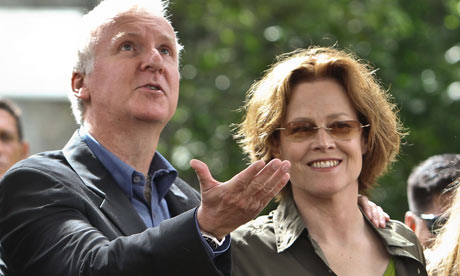
In a recent interview with a Brazilian news site, Sigourney Weaver claimed that the reason James Cameron and his mega-blockbuster Avatar were beat out by Katherine Bigelow and The Hurt Locker, her production about the war in Iraq, was because Cameron was not a woman. Or, in her words, the reason Cameron could not snag the Best Director trophy was because ‘[he] didn’t have breasts.’ After reading Levy’s work earlier in the semester, these comments seem to shout ‘female chauvinist pig.’
Although Levy spends most of her book framing female chauvinism in terms of sexual exploitation—women who use their sexuality as a tool or who embrace raunch culture as empowering without fully considering its implications—she also argues that the lack of camaraderie among women only perpetuates their marginalization and subjugation. Levy delineates this phenomena into two components: women who have made it into the boys’ club and are hesitant to pave the way for more women and women who want to identify with a privileged (i.e. patriarchal) ideology. In a world where men still wield the power of the privileged it is often considered a shrewd move for women to align themselves with the boys’ club mentality.
Of course, this mentality runs counter to feminist ideals in a number of ways. According to Levy’s book, female chauvinist pigs achieve their brand of empowerment through eschewing traditional feminist notions of sisterhood, which undermine the established male-dominated hierarchy. This mentality, however, does not support other women and inhibits the formation of potentially powerful social collectives. Although Weaver’s comments seem pretty benign—after all, she did star in Avatar, so it is understandable that she would have been rooting for it—they still typify the chauvinist attitude that undermines women’s efforts to become equally valued contributors to the workforce as well as society at large.
Of course, the politics that go into awards show decisions have long been a subject of speculation. Even the recent expansion of the Best Picture field at the Oscars from five nominated films to ten was largely the result of frustration that certain types of movies were being underrepresented, not due to lack of achievement but because Academy voters have been notoriously prejudiced against certain genres of film. (In particular, the change was believed to be in response to the exclusion of The Dark Knight from the Best Picture nominees in 2009 and the widespread belief that that exclusion stemmed from Academy voter’s hesitance to recognize a superhero film, even an exceptional superhero film.) The politicization of Bigelow’s bid for Best Director, as the first woman in decades to be nominated and the first female director ever to win, was evident not only in the buzz leading up to Oscars night, but also in the ceremony itself.
Bringing Bigelow’s gender into the equation seemed to produce contradictory results. On one hand, it was a significant occasion and Bigelow’s recognition in a field that has been almost exclusively dominated by men was an important moment. However, the politicization of her nomination and bid for the statue also introduced speculation that she could not lose because of her gender and invited comments such as Weaver’s to undermine the quality of her work. The lack of female directors recognized by the Academy has given rise to comments about gender imbalance in the field and speculation over reasons women’s contributions were going unnoticed. To snub a female director whose work is worthy of the win, some argued, would only cement the Academy’s reputation as having a boys’ club attitude. As such voters’ hands were forced to vote for Bigelow and The Hurt Locker if they wanted to maintain some semblance of gender equality. Even Barbara Streisand’s comment upon announcing Bigelow’s win (“about time”) noted both the lack of recognition of women and the growing restlessness surrounding it.
The contentiousness of Bigelow’s win and the dual response generated by it only further highlight the ways professional women’s achievements are being downplayed because of the marginalization of women as professionals on a larger scale. In many ways the difficulties women face parallel the racial inequalities based on white privilege that Peggy McIntosh discusses in her essay White Privilege: Unpacking the Invisible Knapsack. McIntosh argues that subordination of marginalized groups can be attributed not only to outright acts of racism (or in this case, sexism) but also to the more subtle privileges enjoyed by those in power. As a member of a marginalized group, Bigelow does not have the privilege of her achievements being recognized as a result of her labor and skill and they are instead attributed to her gender. In this way, even women who manage to break into male-dominated fields and triumph face subordination by virtue of the very obstacles they overcome. The subtext of Bigelow’s win can be interpreted as follows: her work was noteworthy for a woman’s work; the Academy could not afford to ignore a woman’s achievement even if it did not match that of men in her field; Bigelow won because the Academy felt they needed to honor a woman.
The double bind presented here is obvious and links back to Marilyn Frye’s discussion of the ‘birdcage’ of oppression in her essay Oppression. Frye argues that women’s subordination weaves a complex structure, and while it might be possible to tease out and analyze any one element of female oppression, they mesh together in so many inscrutable ways that they form an inescapable cage. In this case, Bigelow overcame the obstacle of being a professional woman in a male-dominated field, only to have the same issues she overcame be used by a fellow woman to undermine her work. Her status as a woman, which no doubt made earning recognition and respect harder, was also used to downplay those honors.
However, reducing Bigelow’s win to a token of gender neutrality ignores other key issues and reveals a continuation of long-standing patriarchal values. For example, it does nothing to address the very real fact that women have been sadly underrepresented in film awards outside of actress categories and categories more fit to typical female roles such as wardrobe design.
Furthermore, James Cameron’s loss to Bigelow (as well as Avatar's loss to The Hurt Locker), can be discussed in terms of other political issues that do not necessary have to do with gender. Avatar, while technically brilliant, was narratively simplistic with less fully-realized characters than those in The Hurt Locker. Furthermore, Avatar was essentially a sci-fi film, which is yet another genre that Academy members have been hesitant to recognize, and had some problematic racial undertones. In my mind, the choice to reward Bigelow rather than Cameron was a choice to represent story-telling over spectacle. Yet despite all these other factors, the race to for the Best Director statue became an issue of gender. As a patriarchal society, it was most important to undermine Bigelow’s achievement in terms of her gender and Weaver’s comments only further reveal the chauvinism behind that impulse.
The suggestion that Bigelow won Best Director because she ‘has breasts’ not only reveals the ways in which successful women are continually marginalized, but also underscores the lack of female camaraderie amongst professional females. Weaver’s comments dismiss Bigelow’s directing achievement while also realigning her with the subjugated position of sexual object by drawing attention away from her work and to her sexuality—i.e. she has breasts. In this way, Weaver posits herself as ‘one of the guys’—she does not feel an overwhelming urge to identify with and encourage other professional females and suggests her own willingness to be complicit in female objectification—and thus aligns with the hegemonic patriarchy. While this tactic might work for personal gain, it is a short-term solution to a problem that reaches back generations. It undermines the efforts of professional women and negates the possibility of genuine female empowerment through collective social movements.
References:
Marilyn Frye. 1983. The Politics of Reality. Trumansburg, N.Y.,: The Crossing Press.
McIntosh, Peggy. 1997. "White Privilege: Unpacking the Invisible Knapsack." In Race: An Anthology in the First Person, ed. Bart Schneider, 120-26. New York: Three Rivers.


